
by Elif Carrier
18 Jun 2026
From Guerilla Intervention to Public Commission: An Essay and Interview on Hulda Zwingli’s New Public-Space Artwork MUTTERLAND for the public art festival The Zurich Archipelago – Recreating Common Grounds

The Zurich Archipelago – Recreating Common Grounds is a performative public art festival in Zurich, organized as a project by the City of Zurich’s Art in Public Spaces / KiöR and curated by Mirjam Varadinis. Drawing on Édouard Glissant’s idea of the archipelago as a model for “multiplicity, openness, and movement,”¹ the festival unfolds across the city as a series of connected but distinct artistic “islands,” inviting audiences to actively engage with works that rethink public space as a collective, participatory field. Hulda Zwingli’s participation continues an existing dialogue with Mirjam Varadinis: after their collaboration on ReCollect! at Kunsthaus Zürich in 2023–24, MUTTERLAND carries this conversation from the museum into the city. Within KiöR’s official public-space framework, the work extends Hulda’s feminist critique into the urban spaces of Zurich that have been central to her practice since 2019.
But who is Hulda Zwingli? On her Instagram account, the viewer first encounters a portrait of a female figure wearing a white headscarf and purple glasses marked with Venus symbols. She gives her birthday as 14 June, the date of Switzerland’s Women’s Strike, and describes herself as a Zurich native, a multiple personality, and someone who “will end up being burned at the stake.” The phrase refers to the history of women punished as witches, rebels, or disobedient voices; in Hulda’s case, it becomes part of a self-mythology that is humorous, defiant, and historically aware. This self-description continues through the hashtags #wearehulda, #huldaforpresident, #huldawho, and #nastyhulda, which stage Hulda as both a fictional character and a collective voice.
Scrolling through Hulda’s account, however, it quickly becomes clear that she is more than an Instagram figure. Hulda makes artworks, gives interviews, participates in exhibitions, enters collections, sells works, and has recently published her first book, Hulda Zwingli: Kunst, Macht & Ohnmacht, with Edition Clandestin. Behind this public persona is an anonymous collective of women artists whose number, ages, and backgrounds remain undisclosed. Her name brings together the patriarchal legacy of the Reformer Zwingli and Hulda Zumsteg, the legendary co-founder of Kronenhalle, who was also an important art collector. Through this playful yet carefully considered name combination, Hulda Zwingli turns Zurich’s male-coded civic history into a figure of feminist agency. As a persona and shared identity, she challenges systemic gender inequality across institutions, public space, the art market, and wider society.

She counts discrepancies and makes them visible. She uses satire, research, and social media to confront the male-dominated power structures of the art world: the myth of the singular male genius, the authority of institutions, the unequal distribution of visibility and the systems of value that decide who enters collections, whose work is sold in the art market, who appears in public space, and who is allowed to be remembered in art history.
In this sense, Hulda can be understood in relation to other artistic personas such as Claire Fontaine, the collective founded by Fulvia Carnevale and James Thornhill, whose work Foreigners Everywhere gave the 2024 Venice Biennale its title and inspired its theme. Both practices adopt a feminine subject position, speak in the third person singular, and use a fictional artistic identity to question authorship, the myth of male genius, and the political and economic power structures that shape society. Yet Hulda’s specificity lies in the way she uses anonymity, humour, local embeddedness, and a network of knowledge to confront and negotiate the very power structures she criticizes.
This force becomes especially visible in MUTTERLAND, through which Hulda enters the official field of public space. The work returns to the empty pedestal of the former Turner monument in the Arboretum, originally installed in 1898 as a heroic image of the trained male body, national belonging, and civic virtue. After the figure was repeatedly knocked down in the late 1980s, it was removed from public view. The pedestal was left empty, yet the inscription VATERLAND, NUR DIR!, translated as FATHERLAND, ONLY TO YOU!, remained. Hulda responds to this charged absence with a minimal but pointed gesture: she places the three red letters MUT over VA, transforming VATERLAND, NUR DIR! into MUTTERLAND, NUR DIR! She also turns the empty pedestal into a temporary platform where visitors are invited to climb, take a stand, pose, photograph themselves, and publicly occupy the space on their own terms.
The following interview explores Hulda’s new work MUTTERLAND, presented as part of The Zurich Archipelago – Recreating Common Grounds, through her own perspective, asking how this specific project allows an anonymous feminist fictional figure, rooted in guerilla intervention and institutional critique, to enter an official public art commission without losing her critical voice.
Elif Carrier: Dear Hulda, in 2023 you have before transformed the inscription VATERLAND into MUTTERLAND through a guerilla intervention on the Arboretum pedestal. Now you return to the same site through an official city commission. How does this change the meaning or impact of the gesture?
Hulda Zwingli: By accepting an official invitation, we bring the institutions on board, and they are compelled to engage with the content. Hulda can tap into greater resources. In public space independent installations of this kind would not be possible. Furthermore, the possibilities for communication are expanded. Since we also remain anonymous to the city, we are not deviating from our concept in this case, and we anticipate a greater impact. Plus, it is great when, for once, the costs are covered.
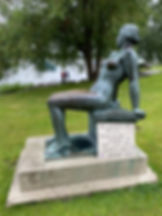
Elif Carrier: Your earliest works exposed the gendered codes of Zurich’s public art through staged photographs, nude female statues, and cardboard signs. What does it mean to move from guerilla intervention into an official public art festival?
Hulda Zwingli: We had already encountered this conflict with the exhibition at the Kunsthaus and other collaborations. Having one foot in the institutional world actually helped us move forward; it gave us a glimpse behind the scenes and did not limit our options. The only risk is that our anonymity is somewhat endangered, despite legal agreements.
Elif Carrier: Can Hulda still disturb the city when the city has invited Hulda in?
Hulda Zwingli: In general, Hulda’s approach has been so successful that the most glaring shortcomings are no longer so obvious. It now takes more investigative work to uncover them. It is wonderful that institutions are taking notice and reforming themselves from within. We benefit from these changes and can turn our attention to global issues.
Elif Carrier: Hulda enters the very systems she criticizes: museums, collections, the art market, and now public art commissions. How do you keep the critical force of the practice from being neutralized?
Hulda Zwingli: Anonymity is the key factor— it is surprisingly powerful. The power and appeal of the pseudonym really took us by surprise. It is also up to us not to let anyone muzzle us. Ann Demeester asked us to continue speaking out critically.
Elif Carrier: What first drew your attention to the empty Arboretum pedestal and the inscription VATERLAND, NUR DIR?

Hulda Zwingli: During our actions around monuments, we discovered several empty pedestals and used them for protests. The slogan “VATERLAND, NUR DIR!” left us speechless, and when a young man bowed before it with reverence and solemnity, we felt uneasy. The whole scene seemed surreal and somewhat frightening to us. For Women’s Strike Day 2023, we decided to reimagine the pedestal using three wooden toy letters. Since we could not climb up, we came up with the idea of a staircase from the back. We had long noticed that there are only two monuments dedicated to women in Zurich and had been thinking about who is allowed to climb a pedestal.
Elif Carrier: MUTTERLAND relies on a minimal typographic shift: MUT placed over VA. How did this act of overwriting emerge?
Hulda Zwingli: It was a spontaneous idea for the Women’s Strike, born out of anger—WUT—that only half of humanity dominates the public sphere in every respect.
Elif Carrier: MUT means courage, but, as you also said, it also sits close to WUT, which in German means rage. How do anger and courage relate in this work and in your overall practice?
Hulda Zwingli: Hulda certainly acts out of anger at how unequally resources are distributed and how starkly this is reflected in art and public space. Anger is a driving force. It also takes courage to put oneself out there. As an anonymous figure, it is much easier to clearly denounce injustices.
Elif Carrier: Instead of replacing the missing Turner figure with another fixed monument, MUTTERLAND opens the pedestal to visitors. What changes when the monument becomes a temporary, living body?
Hulda Zwingli: In our system, where everyone can and should participate, the cult of heroism is not something to aspire to. The pedestal now offers everyone a platform to reflect on different social questions: from MUT, courage, to WUT, anger, from body ideals and participation to notions of gender roles and even with fall protection.
Elif Carrier: The official version includes a staircase and railing. How do you understand this added infrastructure: as support, compromise, regulation, or part of the work?
Hulda Zwingli: At first, we found the fall protection required by safety standards aesthetically jarring. We eventually came to terms with it because it makes climbing to the pedestal possible, even for several people of different generations at the same time.

Elif Carrier: Visitors are invited to climb the pedestal, take a position, and share a selfie. What role does the selfie play in the work?
Hulda Zwingli: We are happy to leave that up to the visitors and look forward to discovering new aspects of the installation. Maybe someone would even like to give a speech.
Elif Carrier: The festival speaks of “common ground,” while MUTTERLAND shows that public space is never neutral. What does common ground mean to Hulda?
Hulda Zwingli: We can learn from historical conditions. Hulda was surprised and angry that changed behaviour takes so long. It took until 2026 for this aspect to be broadly discussed in Zurich’s public space. There was not much public discussion in Zurich about the gender balance in public space in the years before Hulda Zwingli. Bice Curiger made photos of street names and pointed out the imbalance in that field in the 70’s.
Elif Carrier: MUTTERLAND is presented alongside participatory works involving food, plants, walking, reading, cooking, knitting and gathering. How do you see Hulda’s contribution within this wider festival ecology, and what should remain after the festival ends?
Hulda Zwingli: Hulda is looking forward to the other contributions and hopes that they will spark public discussion through many encounters. Well-being depends on the design of public space and on positive encounters within it. Public space cannot simply be zapped away, and we hope that MUTTERLAND will be turned into a permanent installation in the future.
Notes:
About,” The Zurich Archipelago – Recreating Common Grounds, accessed June 7, 2026, https://www.zurich-archipelago.ch/en/about.