
From the US to Zurich. George Rickey’s Two Rectangles Vertical Sculpture. Variation III
- Mar 6
- 4 min read

“Motion, which we are all sensitive to, which we are all capable of observing without having to be taught, is a sensation that appeals to the senses just as color does. It has an equivalent of the spectrum, different kinds of types of motion. I think that one can, to a very considerable extent, isolate motion as a visual component and design with that.”
George Rickey
Described in German as Windkinetische Skulptur, George Rickey’s large-scale sculpture Two Rectangles, Vertical Gyratory Up, Variation III reveals itself as a delicate force of motion, rotating in tandem with the wind, light, gravity, and passersby.

It was on a sunny summer day when it first caught my eye. As I looked up, I was surprised I hadn’t noticed it before. Massive yet somehow lightweight, its polished surface reflected rays of light into the clear blue sky. Its wings moved sequentially, even though there was barely a breeze, at a measured yet random pace that made me slow down, stand still, circle around it, pause my thoughts, contemplate, experience it, and ultimately capture it on my camera roll from every possible angle.
This momentum lingered with me. And when my friend and founder of the [site specific] platform invited me to write, I thought of giving it a try and, on this occasion, learn more about this sculpture I admired, especially since there is no information to be found about it at its location.
What began as a simple Google search turned into something of an investigation. The sculpture seemed to have vanished from public view for six years... and surprisingly little information about it exists overall. More questions followed: How many variations exist? Where are they located? But let’s start with Variation III.

Created in 1970 by American artist George Rickey¹ (1907–2002), the sculpture Two Rectangles, Vertical Gyratory Up, Variation III has been on public display in Zurich for the past 26 years, located in the heart of the city at Brandschenkestrasse 5, 8001, just a few meters from the Alter Botanischer Garten, along the Schanzengraben promenade. The sculpture sits in front of the UBS Headquarters, and that is not by chance.
Its journey starts in the US. It was originally installed on the Rensselaer Polytechnic Institute
campus in Troy, New York, in 1972, lent to Rensselaer by Rickey himself, who had previously served there as a professor of Art. The wind-powered sculpture, made of chrome stainless steel, 8.60 m high, with two wings 6 m long and 20 cm thick, with an abstract geometrical shape, stood at the center of the campus for 12 years, from 1972 until the summer of 1984, and was colloquially referred to as The Chrinitoid by the students. However, due to unsuccessful financial negotiations between Rickey and the Institute regarding its acquisition, the sculpture was dismantled and returned to the artist’s studio. After a six-year absence, it was acquired by UBS and found its permanent place in Zurich in 1990.
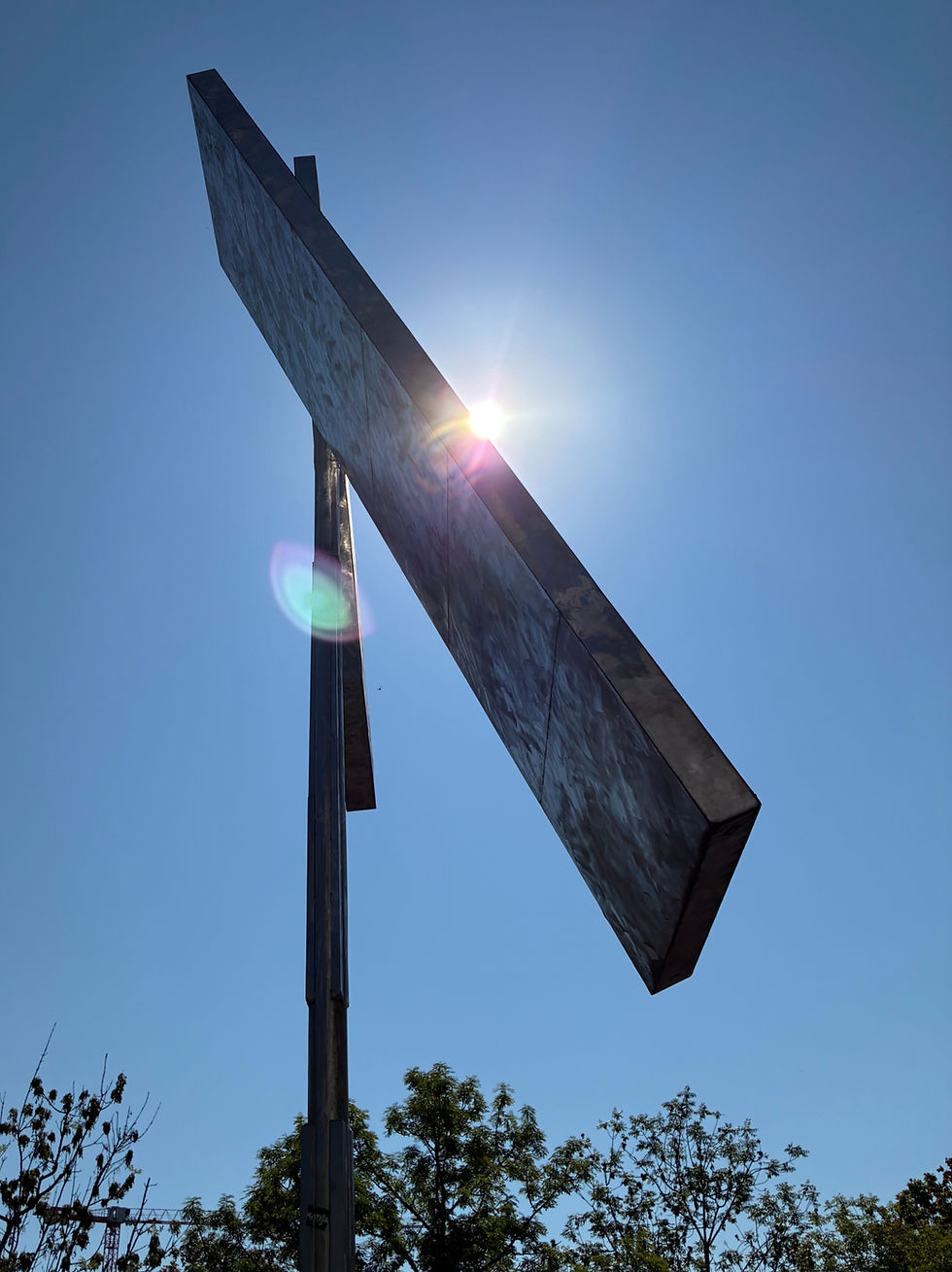
Visually reflective, the outdoor sculpture is composed of two large rectangular panels engineered to move independently, each rotating on a single axis in a unique and ephemeral way in response to the wind, set in motion even by the subtlest breezes. The artist has successfully combined engineering with aesthetics in an elegant and harmonious manner. The perfectly calibrated kinetic sculpture interacts with its natural and built environment. The surface, as in many of Rickey’s works, is imperfectly polished stainless steel, dispersing rays of light on sunny days.
While I am grateful for my immersive moment, I keep wondering whether Zurich will be its permanent and final home. Other questions arise too... How resilient to change can public art truly be? How many of the people walking by are actually noticing? What does this work represent? Is it a form of balance in a constantly changing world, a statement of financial ability, or simply an intimate momentum of tranquility? As art is ultimately a personal experience, and while it opens many questions, I encourage everyone to encounter the artwork for themselves and perhaps find the answers within.
Text by Roxana Calin
Address:
Brandschenkestrasse 5
8001 Zürich
Switzerland
Acquired by:
UBS Switzerland, 1990
Notes:
George Rickey - a prolific artist and one of the most significant sculptors of the 20th century.
George Rickey was born in South Bend, Indiana, USA, on June 6, 1907. Encouraged by his father, a mechanical
engineer, and his grandfather, a clockmaker, he pursued art studies in Oxford, Paris, and Chicago.
Extremely skilled and passionate, he worked as a painter, muralist, and sculptor. Inspired by
Alexander Calder’s work, he is best known for his large-scale, geometric kinetic sculptures made of
stainless steel, reflecting their changing surroundings and naturally powered by air currents.
Rickey combined his artistic and engineering skills to create complex types of movement, utilizing
harmonic and gyratory motion to expand the potential of kinetic art. He designed his pieces to rely
on the laws of nature, wind power, and gravity. Many of his artworks were created to be displayed outdoors in public spaces and are part of major museum collections worldwide. The Two Rectangles Vertical Gyratory Up variations and series, inspired by the same principles, can be found in New Zealand, the Netherlands, and the US.


