
Seeking Light in the Darkness: The Madonna with Child at Notre-Dame de Paris
“Again Jesus spoke to them, saying, “I am the light of the world; he who follows me will not walk in darkness, but will have the light of life.”
(John 8:12, RSVCE)
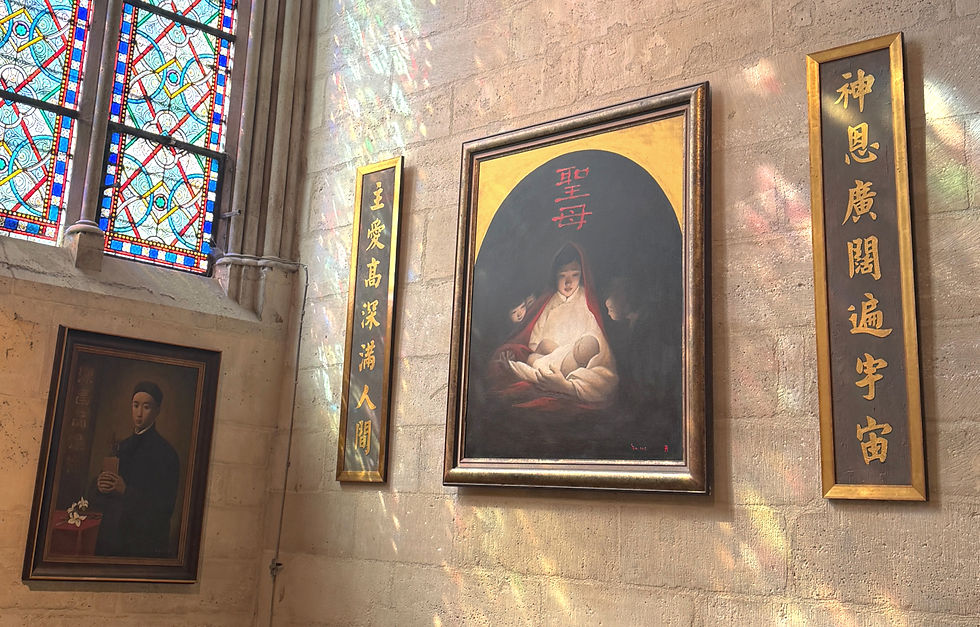
A painting, oil on canvas, depicts the Madonna with Child with Chinese features. In the darkness, Our Lady gazes at Baby Jesus, surrounded by three curious figures. A bright light shines from the Holy Child as His mother looks lovingly at Him. As she gently holds the Child, the scene captivates the viewer, no longer fearfully lost in the dark, admiring the Madonna wearing a white robe and a red veil. Just above the Madonna and Child are two bright red Chinese characters: Shengmu聖母, meaning the ‘Holy Mother’. Above, a golden background appears, almost encircling the scene. On the two sides of the painting, as also carefully noted by Bruno Lepeu, who described the same painting in detail, two couplets are placed: 神恩廣闊遍宇宙 (God’s grace, vast and boundless, fills the entire universe) and 主愛高深滿人間 (The Lord’s love, profound and exalted, fills the human world)¹.
While paintings rarely qualify as semi-public art, a designation more readily associated with sculpture, murals, or site-specific installations, this work represents a compelling exception: permanently installed in a freely accessible chapel within a cathedral that Notre-Dame de Paris itself defines as open to all, without charge or condition, it transcends the boundaries of private and institutional art, occupying an unusual threshold where the sacred, the civic, and the universally accessible converge².
This painting by Yin Xin 尹欣 (b. 1959), alongside another one depicting Saint Paul Chen Changpin 陳昌品 (1838–1861), is preserved in the Chapelle Saint-Paul-Chen, the former Chapel of the Holy Childhood. On May 27, 2018, these two artworks were placed in the chapel and blessed, establishing a historic moment in the history of Chinese Catholic art. Following the 2019 fire that damaged parts of Notre-Dame and the subsequent reconstruction efforts, the chapel underwent restoration, with the artworks positioned slightly differently. The couplets, first placed on the sides of a statue celebrating the efforts of the Holy Childhood Association, were then positioned next to the Madonna with Child painting. The portrait of Saint Paul Chen was also repositioned, centering the scene on his saintly presence after the renaming of the chapel.
When I met Yin Xin in front of Notre-Dame, I immediately sensed his profound bond with the two paintings permanently displayed there. Chinese Catholic art with Yin Xin had officially made its way to Notre-Dame, and these two artworks were now publicly displayed for believers and other visitors. As more people approached the chapel where Yin Xin and I stood for some time, they asked the artist questions, who kindly responded and shared his deep respect for Notre-Dame and the long history of the Catholic Church in China. Some people stood there in admiration for a while, and others took a quick picture with their smartphones, leaving the chapel right after. All of them paused, at least for a moment, to admire the Madonna with Child and the portrait of Saint Paul Chen. Yin Xin’s humbleness pervaded the whole scene as more people arrived. He patiently welcomed more questions and recalled, later, his first time gazing at Catholic artworks in Europe, experiencing a ganjue 感覺, a sensation or feeling, that was difficult to express in words. This initial feeling moved him during his artistic journey and personal path. Just like the artist earlier, now other visitors and Catholic believers experienced the same ganjue 感覺 in looking at his art.

The Chiaroscuro: Yin Xin's Sacred Art of China, An Exhibition in Homage to the Masters exhibition (November 23, 2025–February 17, 2026) at the American Church in Paris further resonated Yin Xin’s admiration for chiaroscuro and the artists who, according to him, inspired his work, from Georges de La Tour (1593–1652) to Caravaggio (1571–1610). In the catalogue of the exhibit, Yin Xin described his first emotions while visiting Notre-Dame:
“When I first walked into Notre Dame, I was immediately struck by the soaring stone construction. I was astounded by all that surrounded me: the sacred music of the organ, the stained-glass windows, the sculptures, the paintings, and the altars. Was it in this place that Westerners purified their souls?”
Yin Xin shared with me his profound connection with art, particularly its transformative impact on him since childhood. Like You Wenhui 游文輝 (1575–1633), known as Manuel Pereira, and Ni Yicheng 倪一誠 (1579–1638), alias Jacopo Niwa, artists who in the early modern era excelled in the production of Chinese Catholic subjects³, Yin Xin continued this tradition, providing a unique opportunity to witness, in his work, a long series of painters who established artistic bridges between China and Europe through Catholic artworks. Like for those early modern artists, for Yin Xin the encounter with images depicting the Madonna and Child was more than a mere fascination for European artworks featuring Catholic subjects; it was rather an existential journey, as he explained in the catalogue:

“When I began creating Virgin and Child for Notre Dame Cathedral, I immediately thought of La Tour’s candlelight. I meditated on the meaning of this light within the darkness. Calmly, carefully observing everything around me, I contemplated the value and meaning of our existence. I felt like a tiny grain of sand seeing the whole world, like a flower opening up to life. With the smallest light, we can begin to see the beauty, the love, and the hope in life”.
The red veil of the Madonna, illuminated by the glowing light of Christ, is both inspired by Georges de La Tour’s work and Chinese tradition, as Yin Xin mentioned during our visit to the chapel. The same color is shown in Red Scarf (Private Collection, 2004)⁴. There, a similar veil is depicted in a different context as it gently falls over the hair of a woman wearing a red dress. The bright red characters and the veil in the Madonna with Child appear almost as an artistic bridge, connecting the viewer to both the history of the Catholic Church in China and the personal reflections and emotions of the artist. Although the face of the Holy Child cannot be entirely seen, His light radiates in the darkness. The encounter with this scene left me with a sensation I could not entirely explain, and, probably, in this mysterious emotion lies the powerful yet gentle impact of Yin Xin’s art.
As we left the chapel, stained-glass light from Notre-Dame filtered across the walls, the same illumination that had inspired Yin Xin to integrate Chinese and European Catholic visual traditions in his work. That light, witnessed by believers and visitors alike, lingered with us long after the encounter.
Text by Antonio De Caro
Address:
6 Parvis Notre-Dame - Pl. Jean-Paul II,
75004 Paris
France
Commissioned by:
Archdiocese of Paris
Notes:
Bruno Lepeu, “La Chine au cœur de Notre-Dame de Paris,” ADEXTRA – Missions Étrangères de Paris, December 18, 2025, https://adextra-mission.com/la-chine-au-coeur-de-notre-dame-de-paris/, accessed on April 1, 2026.
Note on paintings as public / semi-public art objects from Olena Iegorova, editor-in-chief
Isabel Murta Pina, “Painting for the China Mission during Matteo Ricci’s Time: Manuel Pereira 游文輝 and Jacobe Niva 倪一誠,” Bulletin of Portuguese-Japanese Studies II, no. 2 (2016): 53–67.
Reference painting:

Yin Xin, Red Scarf, Private collection 2004, acrylic on canvas, 27 x 22cm © Courtesy of Yin Xin


